

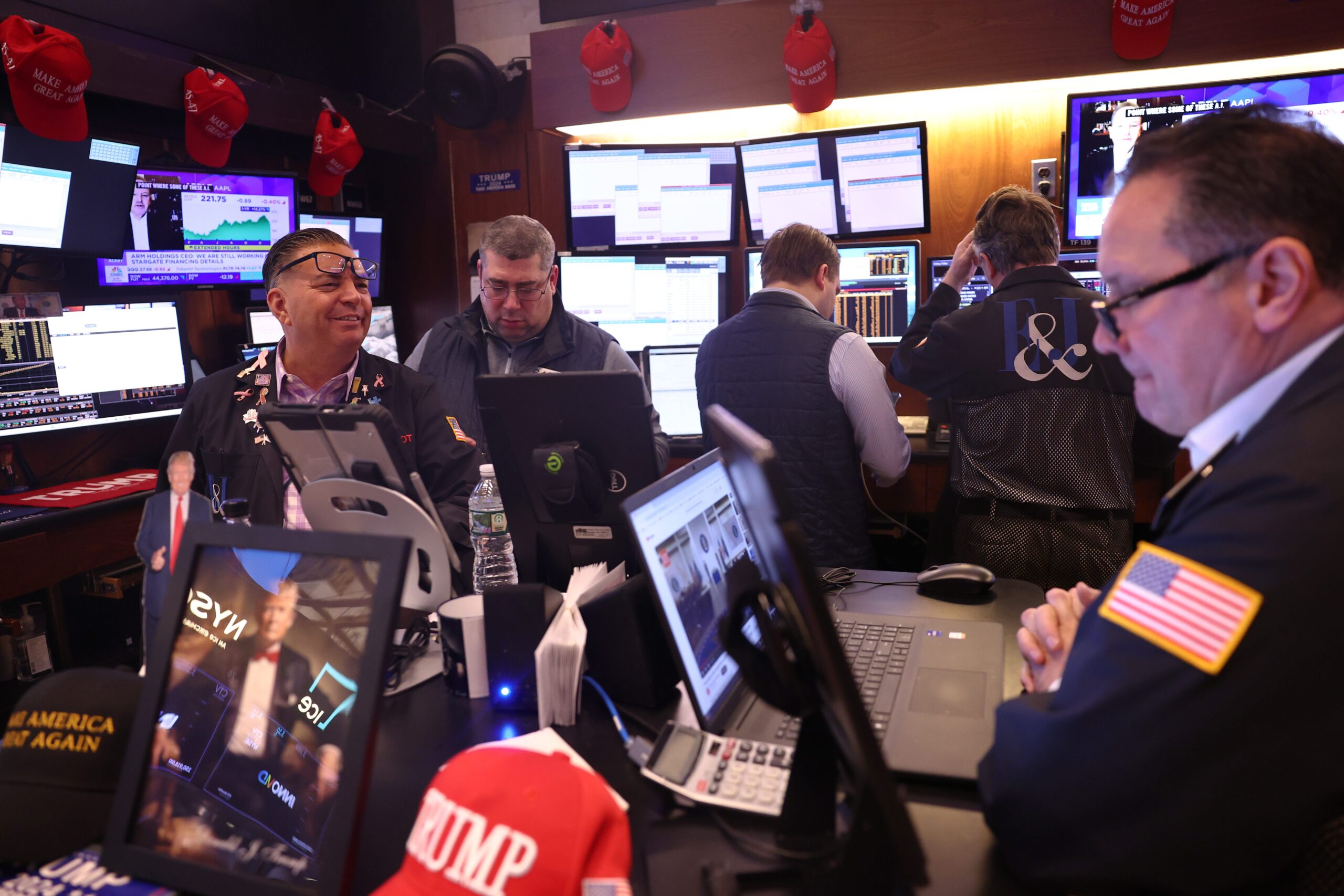
Market Reacts to Mixed Economic Signals: Stocks Edge Higher Amid Job Data and Tariff Uncertainty
U.S. stock markets displayed surprising resilience in early trading Friday, managing to eke out gains despite a weaker-than-anticipated jobs report and persistent concerns surrounding the Trump administration’s trade policies. The labor market data, released earlier in the morning, revealed a divergence from expectations, adding complexity to the economic outlook and raising questions about the Federal Reserve’s future monetary policy decisions.
The February nonfarm payrolls report indicated an increase of 151,000 jobs, falling short of the 170,000 consensus forecast among economists polled by Dow Jones. Adding to the concerning signals, the unemployment rate edged upward by a tenth of a percentage point to 4.1%, exceeding expectations that it would remain steady at 4.0%. This combination of slower job growth and a rising unemployment rate painted a less-than-rosy picture of the labor market, typically a key indicator of overall economic health.
Despite the disappointing data, the major U.S. stock indexes opened higher and maintained a slightly positive trajectory as the morning progressed. As of 10 a.m. ET, the broad-based S&P 500 index was up 0.08%, representing an increase of 4.61 points to reach 5,743.13. The Dow Jones Industrial Average, composed of blue-chip stocks, edged up by 0.063%, or 26.87 points, to stand at 42,605.95. The tech-heavy Nasdaq Composite index demonstrated the strongest performance among the three, rising 0.31%, or 56.58 points, to reach 18,125.83. The benchmark 10-year Treasury yield, a closely watched indicator of investor sentiment, declined to 4.251%, reflecting a potential shift towards safer assets.
Analysts suggest that the market’s relatively muted reaction to the weaker economic data stems from the belief that the figures are not significant enough to drastically alter the Federal Reserve’s course of action regarding interest rates. Despite the subpar jobs report, economists largely anticipate that the Fed will maintain its trajectory of lowering rates later in the year.
Elyse Ausenbaugh, head of investment strategy at J.P. Morgan Wealth Management, commented, "The February payrolls data wasn’t soft enough to change the Fed’s calculus, but we are eager to hear how they are thinking about the bigger picture." She further noted that recent economic indicators, such as declines in consumer confidence and signs of households struggling to spend beyond necessities, suggest a potential growth slowdown. "We think the Fed’s bias is still tilted towards easing," Ausenbaugh added, implying that the central bank is likely to prioritize measures to stimulate economic activity.
However, the upward momentum in the stock market may face limitations due to persistent uncertainty surrounding the Trump administration’s trade policies. The president’s recent actions, characterized by rapid shifts and reversals in tariff impositions, have created a sense of anxiety among investors.
This week alone, President Trump initially slapped a 25% tariff on goods from Canada and Mexico, followed by an additional 10% tax on Chinese goods. He subsequently walked back some of these measures, first exempting the auto sector from the 25% levy for a month and then expanding the exemption to all goods covered under the United States–Mexico–Canada Agreement (USMCA).
This erratic approach to trade policy has induced significant volatility in the market, pushing the three major U.S. stock indexes lower this week and positioning them for their worst weekly performance since September 2024. The Nasdaq Composite even briefly entered correction territory, signifying a decline of at least 10% from its all-time high.
Treasury Secretary Scott Bessent has attempted to downplay the inflationary impact of tariffs, asserting that they will lead to a "one-time price adjustment" rather than sustained, long-term inflation. In an interview prior to the release of the jobs report, Bessent argued that the administration is "not getting much credit" for areas where costs have fallen since President Trump’s inauguration, citing examples such as oil prices and mortgage rates.
Bessent also acknowledged the possibility of a slight weakening in the economy, attributing it to an expected adjustment as the government transitions from public spending to private investment. "Could we be seeing that this economy that we inherited starting to roll a bit? Sure," he said. "And look, there’s going to be a natural adjustment as we move away from public spending to private spending."
In a separate development, President Trump signed an executive order on Thursday aimed at establishing a strategic bitcoin reserve funded exclusively with bitcoin seized in criminal and civil forfeiture cases. David Sacks, the White House’s crypto and artificial intelligence czar, announced this initiative in a post on X, formerly known as Twitter. The executive order also directs the Treasury Department to manage a U.S. digital asset stockpile consisting of other confiscated cryptocurrencies.
Bitcoin responded positively to the news, climbing 1.12% to reach $90,978.25, surpassing the key psychological level of $90,000. This development signifies the growing recognition and integration of cryptocurrencies within the U.S. government’s financial strategies.
In conclusion, the U.S. stock market’s performance on Friday reflects a complex interplay of economic indicators and policy uncertainties. The weaker-than-expected jobs report raised concerns about the strength of the labor market, but investors appear to believe that the Federal Reserve will remain committed to lowering interest rates later in the year. However, the volatile nature of the Trump administration’s trade policies continues to cast a shadow over the market, creating anxiety and limiting potential gains. The decision to establish a strategic bitcoin reserve highlights the growing importance of cryptocurrencies within the broader financial landscape. As the day progresses, investors will continue to closely monitor economic data and policy developments to gauge the direction of the market in the coming weeks.

